
OEM Engraving Plastic Signage in China: Your Ultimate Customization Guide
2026-07-10
When it comes to creating durable, high-visibility plastic signage with precise engraving, Chinese manufacturers like LYSHIRE are redefining quality and customization. But with so many options, how do you ensure your OEM project stands out? This guide dives into the essentials of engraving techniques, material choices, and design collaboration—everything you need to turn your vision into a lasting impression.
Why Engraved Plastic Signs Outperform Printed Alternatives for Industrial Branding
In the unforgiving environments where industrial branding lives, durability isn't just a perk—it's a survival requirement. Printed signs might look sharp on day one, but their surface-level graphics start to fade, peel, or scratch under routine exposure to moisture, chemicals, and abrasive contact. Engraved plastic signs, on the other hand, have their messaging cut directly into the material, so there’s no ink to wear away. That tactile depth means forklift scuffs, pressure washing, and years of UV assault do little more than add a rugged patina while the critical information—safety warnings, pipe labels, directional cues—remains crisp and legible.
Beyond mere endurance, the physical texture of engraving gives these signs a functional advantage that often gets overlooked. In loud plant environments or poorly lit corners, a flat printed label can vanish into the background just when someone needs it most. Engraved characters create shadow and contrast that catches the eye even in glare or dim conditions, and they offer a subtle tactile element for gloved hands. This combination means fewer misreads and faster recognition, which directly bolsters safety and operational flow without adding any complexity to the sign itself.
There’s also a perceptual weight that comes with an engraved sign. It signals permanence, care, and a no-shortcuts mentality that printed alternatives simply can’t replicate. When clients or inspectors walk through a facility, the consistency and professional presence of deeply marked signage subtly reinforces trust in the operation. Custom shapes, beveled edges, and layered color cores further allow a brand to express identity in ways that feel authentic to an industrial setting—steering clear of the disposable sticker vibe and instead grounding the space in a sense of established, long-term quality.
Decoding the Customization Workflow: From Vector Files to Finished Panels
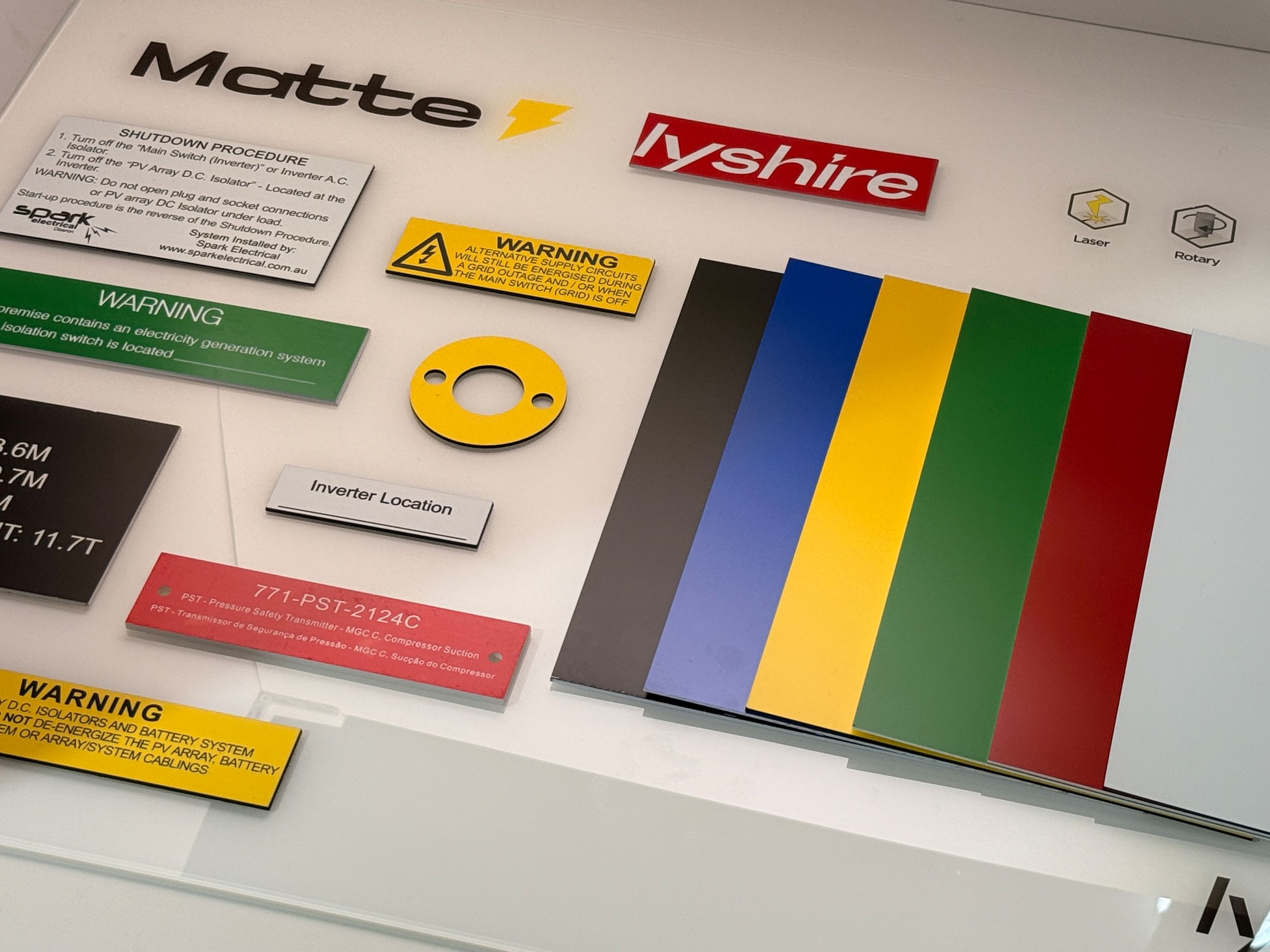
Every custom panel starts life as a precise vector file — an outline of paths and curves that carries not just the shape, but the intent behind the design. These files, usually born in software like Adobe Illustrator or CorelDRAW, define cut lines, engraving depths, and material zones without the ambiguity that plagues raster images. What makes this stage fascinating is how a designer’s abstract concept gets translated into coordinates and bezier curves, setting the stage for machinery to interpret creativity with micrometer accuracy.
Moving from screen to substrate involves a careful handshake between file preparation and production technology. The vector data is parsed by CAM software, which generates toolpaths for CNC routers, laser cutters, or water jets. Here, decisions about bit size, cutting speed, and pierce points turn a digital blueprint into a physical reality. Operators often tweak these parameters based on material behavior — acrylic melts differently than wood, and aluminum demands its own rhythm. This phase is equal parts science and instinct, where a well-nested layout can mean the difference between minimal waste and a costly scrap pile.
The final panels emerge only after finishing touches that blend automation with handwork. Edges are flame-polished or sanded, mounting hardware is integrated, and surfaces get inspected for flaws that machines sometimes miss. A warped sheet or a slightly off-register engraving becomes obvious only when held up to light or fit into its intended frame. It’s in this last mile that the partnership between the upfront vector precision and downstream craftsmanship truly shows — proving that great customized panels aren’t just manufactured, they’re coaxed into existence.
Material Matters: Selecting the Right Plastic for Durability and Aesthetics
When it comes to product design, the material you choose isn't just a backdrop—it's a statement. Plastics, in all their variety, can either elevate a design or undermine its entire purpose. The key lies in understanding the subtle balance between structural integrity and visual appeal. A beautifully crafted chair that cracks under pressure is just as disappointing as an indestructible bin that looks like it belongs in a landfill. Durability is about more than just surviving a drop; it’s about resisting wear, weathering temperature shifts, and holding up against daily abuse without losing its charm. Aesthetics, meanwhile, demand a surface that feels right, a color that stays true, and a finish that doesn’t dull after a few months.
Different plastics offer distinct personalities. Polycarbonate, for instance, delivers impact resistance that’s hard to beat, often chosen for products that need to take a beating without showing it—think eyewear or reusable bottles. Yet its clarity might not suit every design, and it can scratch more easily than you'd like. ABS, on the other hand, blends toughness with a smooth finish, making it a favorite for consumer electronics that need to look sleek while surviving daily use. But leave it in the sun too long, and it might start to yellow. Then there’s polypropylene, with its incredible fatigue resistance, ideal for living hinges on bottle caps. Its slightly waxy feel and limited color depth can be a downside, but for the right application, it’s irreplaceable.
The decision often comes down to context. Will the item live indoors or brave the elements? Is it meant to be hefted daily or admired from afar? A blend might offer the best of both worlds, like adding glass fibers for rigidity without sacrificing surface quality. Even the manufacturing process leaves fingerprints: injection molding can create smooth, glossy surfaces, while 3D printing often introduces texture that can be a feature or a flaw. Ultimately, the right plastic isn't a compromise between durability and aesthetics—it's a match that makes both stronger. When chosen thoughtfully, the material becomes invisible, letting the design speak for itself while quietly doing the heavy lifting.
Mastering Artwork Preparation to Ensure Crisp, Long-Lasting Engravings
The foundation of any great engraving lies in the file you submit. High‑resolution vector art is your best friend here—think .AI, .EPS, or .SVG files. These formats keep edges razor‑sharp no matter how much you scale them, because they’re built on math, not pixels. If you must use a raster image, aim for at least 600 DPI at the final engraving size, and avoid upscaling low‑res photos. Blurry files lead to mushy, disappointing results that no amount of machine tuning can fix.
Beyond resolution, consider the dance between positive and negative space. Engraving isn’t just burning your design into the surface—it’s about what you leave untouched. Fine details like hairline strokes or tiny text can vanish if they’re too thin, or merge together if they’re too close. A good rule of thumb: keep minimum line thickness above 0.5 pt for most materials, and test a small swatch on the actual substrate before committing. Adjusting contrast and removing stray background noise in your artwork also prevents unexpected burn marks that ruin the crispness.
Finally, align your color palette with the engraving process itself. Lasers read colors differently than your monitor—pure black typically triggers the deepest engrave, while pure white tells the machine to skip. Shades of gray or subtle gradients can produce varied depths, but be cautious: too many mid‑tones might yield a muddy appearance. For clean, lasting results, reduce your design to monochrome or a limited grayscale range, and always double‑check that your lines are connected and closed if you’re working with fills. A few extra minutes of prep here saves time, material, and frustration later.
Quality Assurance Practices That Distinguish Top Chinese Manufacturers
Leading manufacturers in China set themselves apart by integrating quality assurance deep into every phase of production. Rather than treating it as a final checkpoint, they embed rigorous testing and inspection protocols from raw material sourcing to finished product. Incoming materials face stringent verification against international standards, while in-line audits catch deviations early. This systematic approach minimizes waste and ensures consistent output that meets global expectations.
Another differentiator is the emphasis on continuous training and a culture of accountability. Skilled workers regularly undergo upskilling programs, staying current with evolving quality methodologies. Cross-functional teams routinely perform root cause analysis, addressing problems at their source rather than applying quick fixes. Such practices foster a sense of ownership, making quality everyone’s responsibility—not just that of a dedicated department.
Top manufacturers also leverage advanced technologies to elevate their quality measures. Automated optical inspection systems, real-time monitoring sensors, and data analytics platforms enable proactive detection of anomalies. Traceability systems document each component’s journey, aiding swift recalls or improvements. By blending cutting-edge tools with robust management systems, these companies deliver products that consistently surpass buyer expectations, building lasting trust in global supply chains.
Real-World Applications: How Custom Engraved Signage Elevates Equipment and Facilities
In manufacturing plants, custom engraved signage transforms raw functionality into intuitive clarity. Control panels once cluttered with fading stickers now feature crisp, permanently etched labels that withstand heat, chemicals, and years of use. Maintenance teams no longer squint at worn diagrams; they trace a fingertip along neatly aligned legends for every gauge, switch, and emergency stop. This subtle shift slashes response time during critical moments and quietly reinforces a culture of precision.
Medical facilities demand more than just identification—they need sterile, readable guidance in fast-paced environments. Custom engraved placards on patient monitors, oxygen valves, and isolation room controls offer that reliability. Unlike printed alternatives, engraved surfaces resist frequent disinfection without peeling or clouding. A nurse approaching a crash cart instantly grasps the exact drawer layout through tactile, high-contrast text, turning seconds into life-saving action while maintaining a clean, professional aesthetic that patients subconsciously trust.
Public infrastructure tells a similar story. Transit stations, power plants, and university campuses use engraved metal code plates and directory signs that endure harsh weather and vandalism. The depth of each character catches light differently throughout the day, remaining legible even when paint fades. An airport's engraved column wraps do more than display floor numbers—they guide millions with an understated permanence that whispers longevity, not budget compromise. Facility managers value how these installations age gracefully, blending into architectural intent rather than screaming for attention.
FAQ
OEM engraving plastic signage refers to custom-made plastic signs where the manufacturer produces them according to your design specs, often using engraving techniques to carve text or graphics into the surface. Unlike printed signs, engraving gives a tactile, durable finish that won't peel or fade. It's popular for industrial labels, nameplates, and control panels.
Chinese suppliers have decades of expertise in plastic fabrication and engraving at scale. They offer competitive pricing due to lower material and labor costs, while many factories now hold international quality certifications. Turnaround is fast, and they're comfortable handling complex multi-language designs or small-batch orders that Western shops might refuse.
Nearly every aspect can be tailored: choose from materials like acrylic, polycarbonate, or ABS in various colors and thicknesses. You decide on font styles, logo engraving depth, and whether to add color-filling for contrast. Edge finishing, adhesive backing, screw holes, and even backlighting compatibility are on the table.
Most factories use CNC laser engraving or rotary engraving machines. A digital file is fed into the system, and the machine removes a thin layer of plastic to reveal the core color or create a textured surface. For two-tone signs, they often laminate a colored top layer onto a contrasting base, then engrave through to expose the underneath color. It's precise and repeatable.
Always request physical samples before mass production—this reveals finish quality, color accuracy, and durability. Check if the supplier has ISO or similar certifications. A detailed spec sheet with tolerance limits and material grades is crucial. Also, using a third-party inspection service for the first order can catch issues early.
Prototyping might take 3-7 days, and production runs of a few thousand pieces often finish in 2-3 weeks. Shipping depends on the method: courier (DHL/FedEx) for small batches takes 3-5 days, while sea freight for larger volumes can take 20-35 days plus customs clearance. Always factor in Chinese holidays, which can slow things down.
Minimum order quantities (MOQs) vary widely; some suppliers accept as few as 100 pieces, while others insist on 1000+. Expect setup charges for new molds or engraving templates, but these are usually one-time. Shipping and import duties are often forgotten—get a DDP (Delivered Duty Paid) quote if you want a clear total cost.
Conclusion
For industrial environments where labels must endure vibration, chemicals, and UV exposure, engraved plastic signage from Chinese OEM partners offers a compelling alternative to printed decals. Unlike surface-level prints that fade or peel, rotary or laser engraving carves legends deep into the substrate, creating a permanent, high-contrast mark that resists abrasion and harsh cleaning agents. The customization journey typically starts with customer-supplied vector artwork—such as .ai or .dxf files—which the manufacturer refines to ensure optimal tool paths and stroke widths. From there, material selection becomes a strategic decision: impact-resistant acrylics deliver a glass-like finish for luxury control panels, while multi-layer laminates like Gravoply reveal a contrasting core after engraving, maintaining legibility even as the top surface wears. This blend of material science and precision machining ensures each tag or panel meets exact dimensional and aesthetic requirements.
Achieving crisp, lasting results hinges on meticulous artwork preparation—manufacturers often advise on minimum font sizes and line thicknesses to prevent chipping, while color-filled engravings demand careful mask cutting and infill curing. Top-tier Chinese suppliers differentiate themselves through rigorous quality controls: laser measurement systems verify engraving depth within microns, and environmental stress tests simulate years of outdoor exposure in accelerated cycles. Such practices underpin real-world installations ranging from serialized machine nameplates in automotive assembly lines to safety signage in offshore energy platforms, where legibility under low light is critical. By aligning material performance with application demands, OEM partners transform engineering specifications into durable, legible branding tools that enhance equipment traceability and facility compliance over decades of service.
Contact Us
Contact Person: Tina Hou
Email: [email protected]
Tel/WhatsApp: +86 17816238685
Website: https://www.lyshire.com